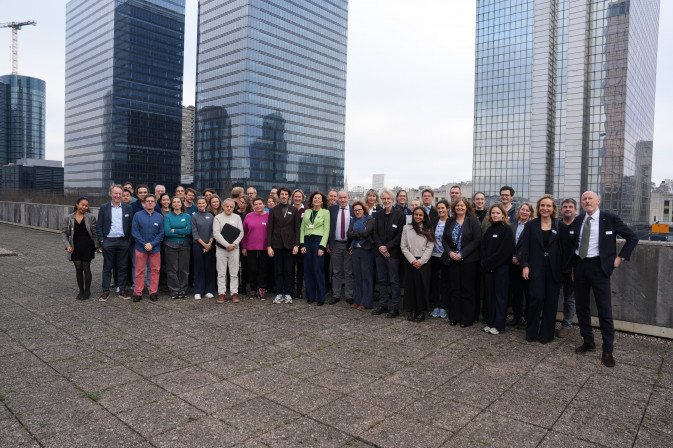
The Equinox Week held in Brussels in December 2025 brought together researchers, policymakers, funders and practitioners to explore two critical dimensions of climate action: societal transformation and the economics of climate change. Organised under the Equinox Process and supported by the MAGICA project, the events created a space for dialogue between science and policy on some of the most pressing challenges facing Europe’s climate transition.
Today, the outcomes of these discussions are available through two newly available summary reports.
The Equinox Workshop on Societal Transformation in the Face of Climate Change, held on 11 December 2025, focused on how social sciences and humanities can support climate action, adaptation and resilience. Discussions explored governance, public engagement, policy design, trade-offs and co-benefits across policy areas, as well as pathways for moving from knowledge to action.
Simultaneously, participants gathered for the Equinox Dialogue on Modelling the Economics of Climate Change on 11 & 12 December, which examined key themes like modelling assumptions and limitations, equity and justice considerations, technology development and carbon dioxide removal, as well as the integration of finance and financial flows. The dialogue highlighted the need for greater transparency, improved communication of model outputs, and stronger links between science and policy – a goal that the Equinox Process continuously strives for.
Together, the two events demonstrated the value of bringing different knowledge communities together under the Equinox Process. While approaching climate challenges from different perspectives, both discussions highlighted a common need: strengthening the connection between scientific knowledge and practical decision-making.
The summary reports are available here:
- Equinox Workshop on Societal Transformation in the Face of Climate Change
- Equinox Dialogue on Modelling the Economics of Climate Change
By making these insights accessible beyond the events themselves, the Equinox Process continues to contribute to informed climate action and evidence-based policymaking across Europe.