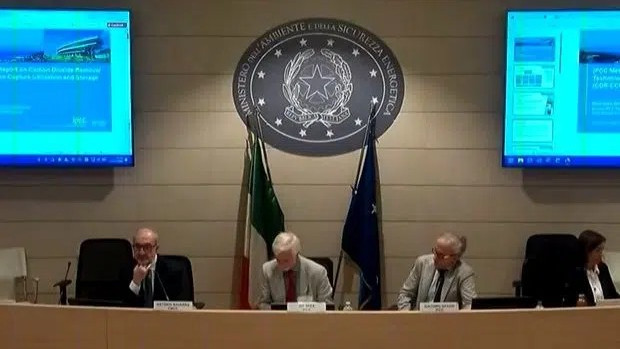
On 15 April 2026, the event “Inside the Intergovernmental Panel on Climate Change: How Global Science Supports Our Future Climate” jointly organised by the Italian Ministry of Environment and Energy Security, the IPCC, and CMCC, brought together over 220 participants on the role of global scientific cooperation in addressing the climate crisis. With contributions from leading experts including the Chair of the IPCC, Jim Skea, the session provided insights into the IPCC’s seventh assessment cycle and ongoing work on key topics such as carbon dioxide removal (CDR).
In the opening panel Antonio Navarra, Chair of JPI Climate and President of CMCC, underscored the long-term nature of climate action and continued need for evidence-based assessment processes to inform policy and decision-making worldwide “climate challenge is not a speed race but rather a marathon, we need consistency and historical memory on climate knowledge, and that is the role of the IPCC that we have to keep alive.”
The Equinox Process an initiative by JPI Climate supported by MAGICA, works in complementarity with the IPCC and aims to foster the dialogue at the science-policy interface and supporting the exchange between scientific knowledge and societal engagement. MAGICA Coordinator and CMCC Director Giulia Galluccio, reflects after the session that “the work we do at European level under the Equinox Process is building upon and also feeds into the IPCC while strengthening the links between research communities – the upcoming Climate Neutrality Forum end of next month will for example provide a comprehensive report to inform climate action.”
As the IPCC advances its seventh assessment cycle, the importance of collaboration across institutions and disciplines is crucial. Together, these complementary efforts will ensure that robust scientific knowledge continues to underpin effective climate action.